Ride Lab
See what your suspension actually did
Ride Lab records a ride with your phone's own sensors and turns it into a report on how the bike behaved. It measures the motorcycle, not you, and everything is worked out on the phone. This page explains what to do and how to read what comes back. For what preload and rebound actually do, that is a different page: suspension basics.
Read this first
Ride Lab measures your bike accurately. What we are still building is the library of context that turns a measurement into a confident verdict, and that comes from real rides on real bikes over time.
So the numbers are solid and the ranges around them will keep improving. Where a reading is close to a boundary we say so rather than pretending otherwise. Expect the interpretation to get sharper as the picture fills in.
What Ride Lab is for
A diagnosis starts from what you felt. Ride Lab starts from what the bike did. The two answer different questions, and the second one is useful when a change is subtle, when two setups feel about the same, or when you want to know whether the road or the bike was responsible for a rough stretch.
It reads the accelerometer and gyroscope your phone already has, plus GPS for speed and distance. It runs while you ride normally. There is nothing to attach to the bike.
Everything is analysed on the phone and stays there. A report leaves your phone only when you choose to share it, as a PDF or as plain text.
Check your mount first
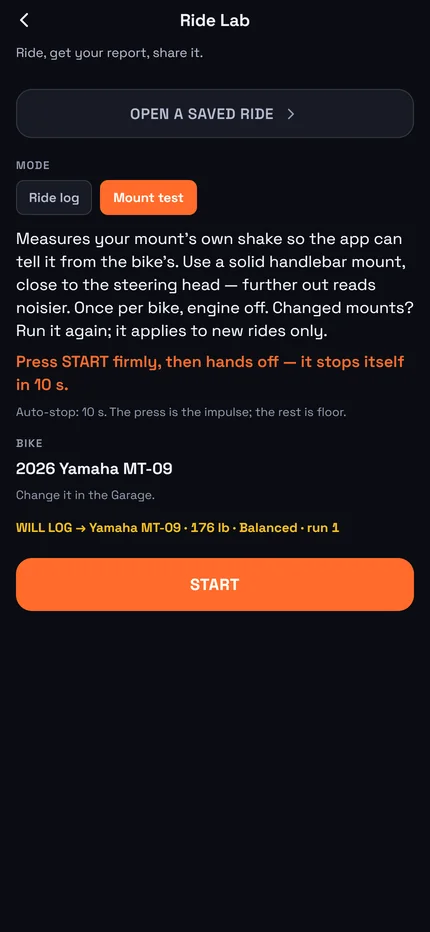
Your phone mount has a wobble of its own, and it lands in the same measurement as the bike's. A soft mount does not just add noise, it adds noise that looks exactly like suspension movement. So the first thing to do on a new bike or a new mount is the mount test.
It takes ten seconds and you do it standing still. Press START firmly, take your hands off, and let it run. It stops itself. The answer tells you how high a frequency your mount can be trusted up to, and therefore which parts of a report to believe.
If the test says the mount is too soft, the vibration rows in a report are describing the mount rather than the bike. A firmer mount closer to the steering head is the fix.
Record a ride
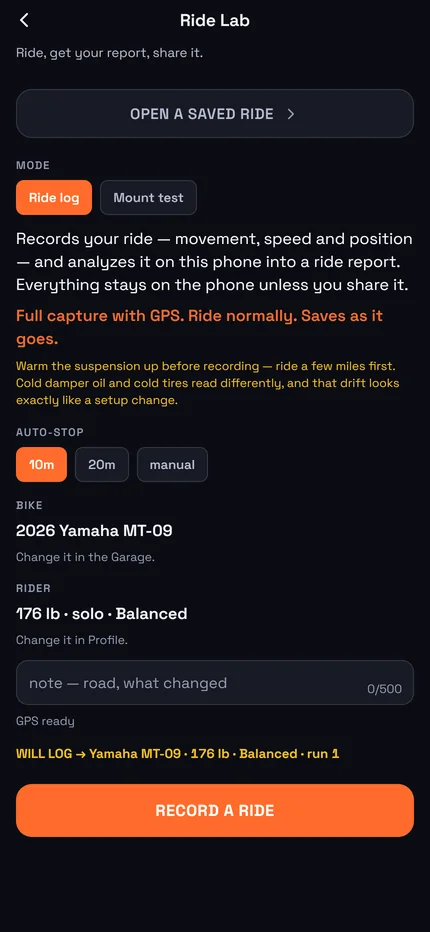
Ride the way you normally ride. Ride Lab is not asking you to perform a test, and there is no route to follow. A varied ten to twenty minutes with some corners, some braking and a mix of surfaces gives it more to work with than a motorway cruise, simply because more things happen.
One thing genuinely matters: let the bike warm up first. Damper oil thins as it warms over the first ten to fifteen minutes and the bike measurably softens. A cold ride compared against a warm one mostly measures temperature.
The ride saves as it goes, so a phone call or a flat battery costs you seconds rather than the whole ride.
Read the report
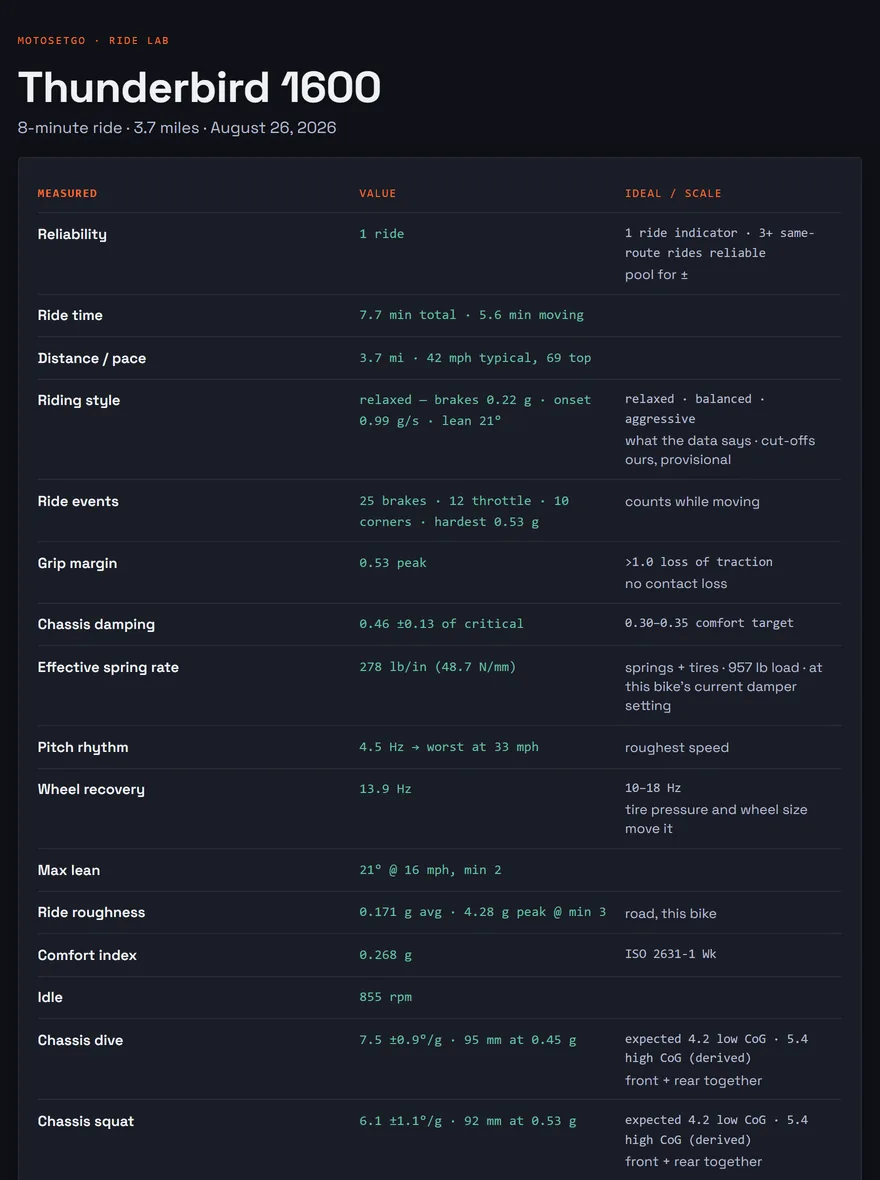
The report opens with the ride itself and then a table of measurements. Every row is the same shape: what was measured, the value, and the range or scale it sits against. Green text is a measured value.
The rows worth knowing first
Reliability is the honest header on the whole page. One ride is an indicator. Several rides over the same road are a figure.
Mount check tells you whether to trust the vibration rows at all. Read it before you read them.
Ride roughness is the road, not the bike, and it is ranked against this bike's own history rather than against other bikes.
Grip margin is how close the tires came to the limit of what the surface was offering. Lower is more margin.
Chassis damping is reported as a direction rather than a verdict: whether the bike is on the firm side or the soft side of the comfort range.
The ride, minute by minute
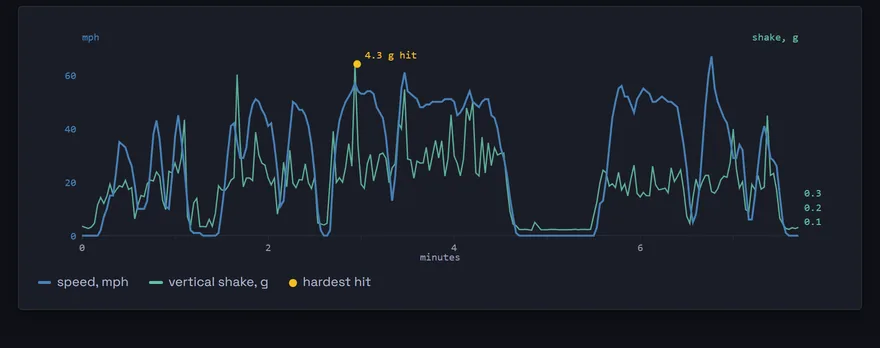
This is the ride as it happened. The useful trick is to read the two lines together: where shake rises and speed does not, the road got worse. Where both rise together, you were going faster over the same sort of surface.
The marked point is the hardest single impact of the ride. If you remember the pothole, this is where it was.
Where the motion lives
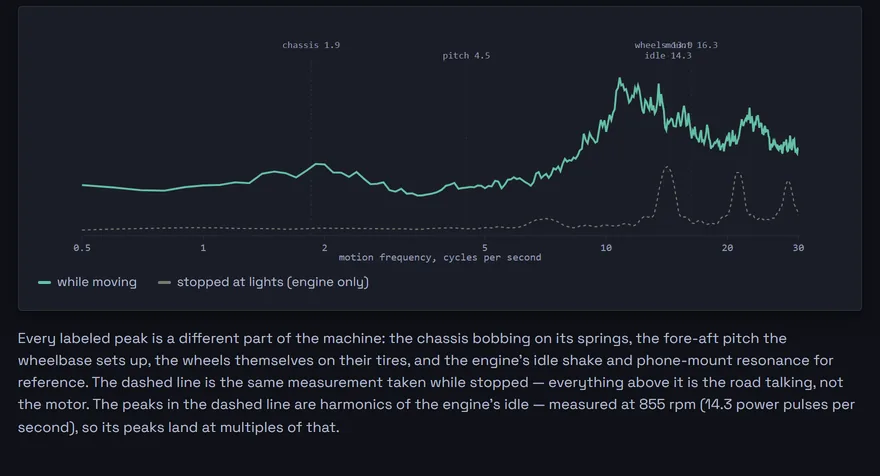
Different parts of a motorcycle move at different speeds, and separating them is what makes a measurement useful. Slow movement is the chassis on its springs. Faster movement is the wheels on their tires. Faster still is usually the engine or the mount.
The labelled peaks name which is which. The dashed line is the same measurement taken while you were stopped, so everything above it is the road talking rather than the motor.
What this ride says
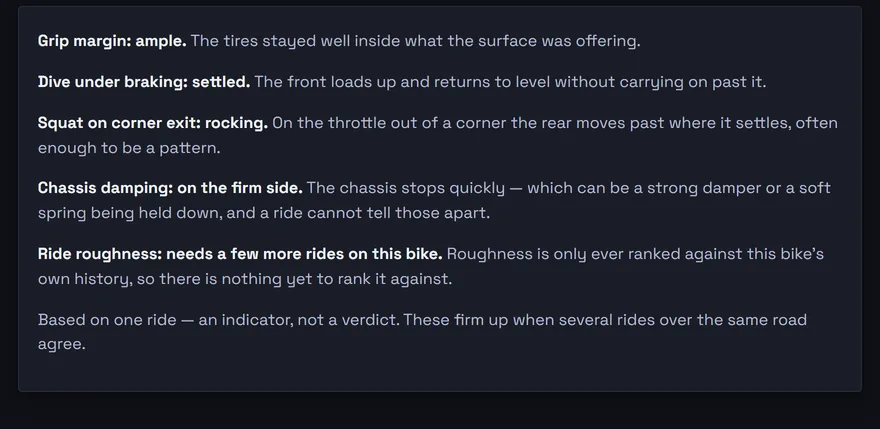
This section is the part to read if you read nothing else. It turns the table above into sentences: grip margin ample, dive under braking settled, squat on corner exit rocking, chassis damping on the firm side.
Notice the two hedges, because they are the point. Roughness says it needs a few more rides on this bike, since roughness is only ever ranked against that bike's own history. And the closing line is there on every single ride: an indicator, not a verdict. If a ride does not contain enough braking or cornering to support a conclusion, it says that instead of guessing.
It does not tell you what to change. Ride Lab reports what the bike did; the diagnosis side of the app is where a symptom turns into an adjustment.
What one ride is worth
One ride is an indicator. It is a real measurement of a real ride, and it is also a single sample of a road, a temperature, a tire pressure and a mood.
Ride the same road a few times and the report starts pooling them, and the figures come with a spread: how much the underlying readings agree. That spread is the thing that makes a comparison trustworthy. If you want to know whether a click of rebound changed anything, the honest test is the same road, warm, before and after, more than once.
This is also why we are careful about ranges. A measurement is a fact about your ride. Turning it into "good" or "bad" needs a picture of what normal looks like across many bikes, and that picture is still being built.
Deeper dive
The motorcycle dynamics behind Ride Lab is not ours and is not new. If you want to go past what this page covers, these are the works our measurements are grounded in. We are not affiliated with any of them.
- Vittore Cossalter, Motorcycle Dynamics The academic reference. Where the motions a motorcycle actually has get named and put in order.
- Tony Foale, Motorcycle Handling and Chassis Design: The Art and Science The engineer's book, written by someone who has built the things rather than only modelled them.
- Gaetano Cocco, How and Why: Motorcycle Design and Technology The clearest introduction of the three, from an engineer who did road and race development at Aprilia.
- ISO 2631-1, whole-body vibration The international standard for how human beings actually perceive vibration, which is why a comfort figure is weighted rather than raw.
These inform the physics. They do not decide what your bike did on your road, and nothing on this page is quoted from them.